BUILDERS / DIGIBYTE DATA / UPDATED OCTOBER 2, 2026
DGB Hashrate Data for Builders — DigiByte Infrastructure Verification
A builder's guide to DigiByte block and mining data: source selection, algorithm-aware metrics, freshness, confirmation handling, caching, and resilient integrations.
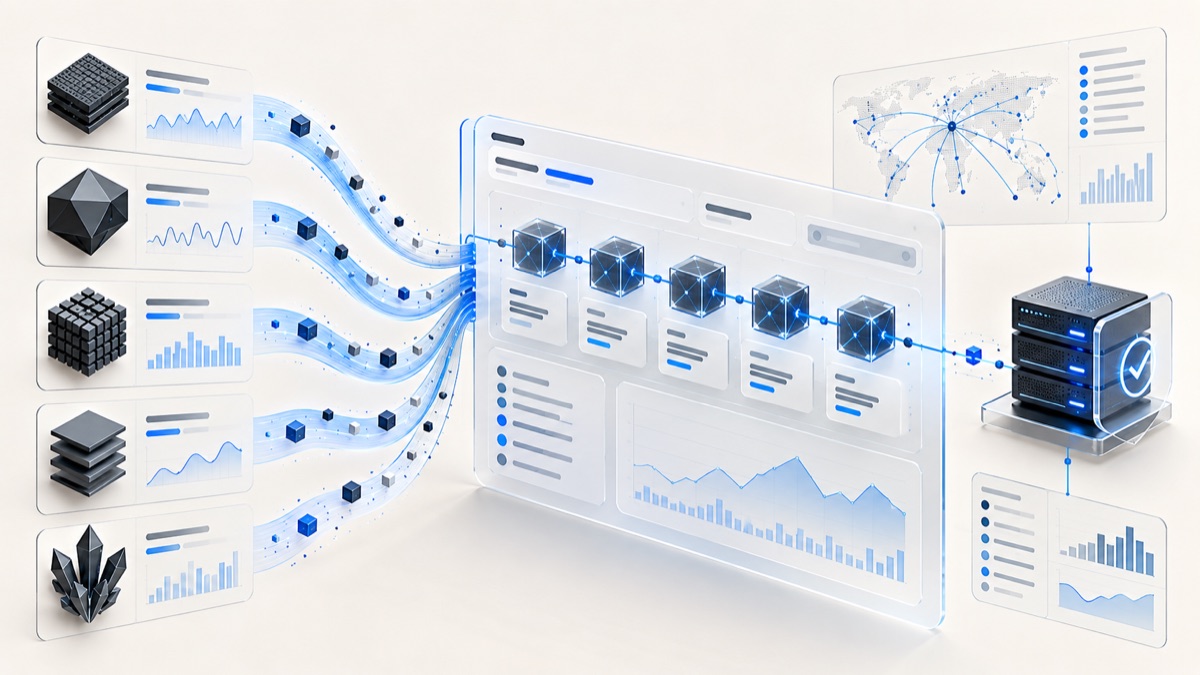
A DigiByte product can use block and transaction data, explorer records, mining-pool statistics, or network-wide hashrate estimates. These signals have different sources and limits. If your interface introduces dgb to users, keep that plain-language context separate from the live data that drives product behavior. This guide shows builders how to choose, label, and maintain the right signal.
Which DigiByte data do you actually need?
Developers often put several measures under the label “network data.” That makes a dashboard look simpler while making its values harder to interpret. Record the source, unit, observation time, and meaning of every field before displaying it or using it in business logic.
| Signal | Useful for | Does not prove |
|---|---|---|
Block height and hash | Showing the latest block known to a node or explorer | That a particular customer payment is included |
Transaction status and confirmations | Tracking a specific transaction against a stated confirmation policy | Irreversible settlement or a guarantee against every chain reorganization |
Per-algorithm hashrate estimate | Observing a modelled network mining trend for the named algorithm and time window | The number of physical machines or an operator's own contribution |
Pool worker statistics | Reviewing a pool's estimate for a worker over its reporting window | A network-wide figure or independently audited hardware output |
Choose a data source that fits the product
For a prototype, a public explorer can make it easier to inspect blocks and transactions without operating infrastructure. For a product with uptime, privacy, or audit requirements, evaluate a DigiByte Core node, an indexer, or a documented provider API. The DigiByte Core repository is the primary place to review the client and its supported interfaces. A third-party explorer is useful for cross-checking, but its availability, retention, rate limits, and data model remain that provider's responsibility.
A practical integration sequence
From a product question to a dependable data feed
- 1. Name the metric
Define the entity, network, unit, algorithm if applicable, time window, and the decision the value supports. Avoid a field called only “hashrate” when the algorithm and estimate window matter.
- 2. Select and document the source
Record whether data comes from your own node, an indexer, a pool, or an explorer API. Document its update cadence, limits, and outage behavior.
- 3. Keep credentials server-side
Do not put node RPC credentials or private provider keys in browser JavaScript. Put a controlled application endpoint between the source and the public interface.
- 4. Preserve freshness and provenance
Store the upstream observation time and retrieval time separately. Show the last update and the source next to a changing estimate.
- 5. Handle pending states explicitly
Treat a transaction as pending until it satisfies your documented confirmation policy. Make retries idempotent and re-read canonical chain state after a timeout or provider error.
- 6. Monitor the integration
Alert on stale data, failed requests, unexpected units, and changes in upstream response shape. Test a provider outage as well as its normal response.
How to display a hashrate estimate responsibly
DigiByte's official site describes a 15-second target block interval and a multi-algorithm proof-of-work network. A target is an average, not a timer for an individual transaction. Hashrate charts are also estimates: their values depend on the underlying difficulty and observation window. Label each chart with its algorithm, unit, source, and window; explain that a network estimate is not a measurement of a named miner.
Put the unit and algorithm in the chart title or legend, not only in a tooltip.
Show when the figure was last observed and how long the measurement window is.
Keep network totals separate from pool or worker estimates.
Mark missing or stale values as unavailable instead of carrying them forward as if they were current.
Link readers to the source methodology and retain the retrieval time for later review.
A short pre-launch review
| Check | Pass condition |
|---|---|
Source | The provider or node and its limits are named |
Freshness | The interface exposes observation time and stale-data behavior |
Semantics | Units, algorithm, network, and estimate window are explicit |
Failures | Timeouts, duplicate events, and provider outages have tested responses |
Security | Credentials stay server-side and public output is validated |
FAQ
Does a 15-second block target mean a payment is final after 15 seconds?
No. It is a target interval for block production, not a finality guarantee. Define the confirmation policy for the transaction and communicate pending status clearly.
Can aggregate network hashrate verify one miner's output?
No. It is a network-level estimate. To assess one operator, request evidence tied to the named pool, worker, algorithm, and reporting interval, and consider how that evidence can be independently checked.
Should a web app call DigiByte Core RPC directly?
Do not expose node RPC credentials to a browser. Use a restricted server-side service or a provider API designed for public access.
Where can a builder start?
Review the official DigiByte Core repository and developer resources, then test the relevant data path against an explorer such as DigiExplorer. Confirm current interface details before deployment.
Sources and further reading
Start with the DigiByte project site, DigiByte Core on GitHub, and DigiExplorer. For publishing a public data view, see the WordPress guide; for assessing an operator, continue to the startup due diligence guide. Browse all Subsocket articles.